
When I Asked Reddit — Late 30s and 40s in CrossFit, and the Direction We're Taking
When I Asked Reddit — Late 30s and 40s in CrossFit, and the Direction We’re Taking
In a conversation with a member at the box, something they said stuck with me more than I expected. As they got older, they’d felt intimidated by the atmosphere at some CrossFit boxes — not because anyone was forcing them, but because when everyone around you is going hard, it’s easy to think “maybe I can push a bit more too.” They’d been injured in exactly that situation. That member had since moved to a newer box where most people are beginners; the vibe is more relaxed, people scale a lot and progress slowly, and they said it feels safer.
That conversation led me to post on Reddit r/crossfit: Do people in their late 30s–40s struggle with the intensity culture at CrossFit boxes? I asked about age mix, injuries, why people leave, and how experienced boxes help older athletes keep training long-term.
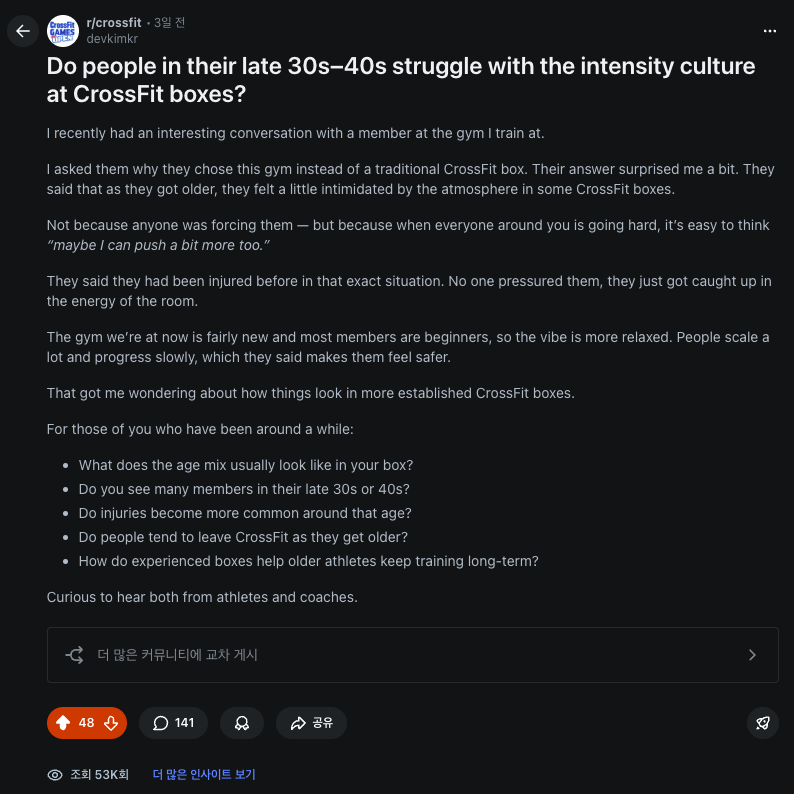
1. The Response — Fast and Many
Replies came faster and in greater number than I’d expected.
People shared experiences from every angle: age mix at their gym, injury stories, why they or others quit, how boxes that keep people for years support them. The same kind of problem I’d heard in person — “I got caught up in the energy and pushed too hard” — showed up again and again in English. It made clear that this wasn’t just my concern; it was shared.
2. The Words the Community Used
Here are some of the phrases from the thread that we’re using to shape our landing and product direction.
The Box vs. What’s in Your Head
One comment put it like this:
The struggle isn’t with the box, it’s with the mentality that you have to keep up with other members.
So the issue isn’t the box or the coach per se; it’s the mindset of having to keep up — and that can lead to overload and injury.
Someone who said they’re 43 wrote:
I had to learn to leave my ego at the door and just concentrate on me and not worry about what others are doing.
A reply to that:
You’re just competing with who you were last week. Bad things happen when you try and compete with who you were 20 years ago.
Who you compare yourself to — “today’s me” vs. “last week’s me,” or “me” vs. “everyone else in the room” — changes whether you last. The community said it in plain words.
Limits, Scaling, and Environment
When people talked about injury, not knowing your limits kept coming up.
Injuries occur when coaching is bad but more importantly (as you grow more experienced) when you do not know your limits.
Someone who got hurt in a “more weight, more more more” kind of box said:
In this kind of energy you really need to know your limits and listen to yourself.
One box’s take:
There is never any shame in scaling.
And there was a clear contrast: some gyms normalize scaling, others have a stronger “push hard” energy. So environment strongly shapes “how much should I push today?”
One comment summed it up:
The focus should always be on quality of movement before intensity.
That lines up with the direction we care about: not “CrossFit culture is wrong,” but good programming, appropriate scaling, quality of movement first.
People Who Left — and “The Desire to Leave”
We also heard from people who’d quit.
I’m not constantly hurting anymore.
Something was always tweaked.
I know at least 10 people that quit because they didn’t want to get injured anymore as they got older. … The most common reason they quit was because they tweaked their backs. That’s a hell of a wake up call.
On the other hand, someone in their 50s who’s been doing CrossFit for over six years wrote:
Yes, I constantly struggle with this desire. [to leave]
So even long-term athletes have moments when they want to quit — and something (community, routine, coaching, programming) keeps pulling them back. That showed up in the thread too.
What They Said About Rest
One person said:
CF seems to be allergic to rest.
Another, reflecting after quitting:
Quitting really brought to light how often you pushed too hard where there wasn’t actually much value for doing so … and also learned that rest is good.
That ties straight into the idea that resting well is training too.
3. The Direction We’re Taking From This
What we took from the Reddit thread, in short:
- The issue isn’t “CrossFit is bad.” It’s how you choose the right intensity and scaling for you today.
- Environment (box culture) makes that choice easier or harder — “push hard” only vs. “scaling is normal.”
- Knowing your limits and listening to yourself matters for reducing injury and dropout.
- Quality of movement before intensity, and valuing rest, fit well with boxes where people train for a long time.
- For boxes that are already well run, we’re not trying to replace them; we want to support them with systematic logging, condition, and scaling.
So the place Rxd Today is aiming for:
- Today decision support
”Should I go Rx or scale today?” “Should I rest today?” — Making daily choices a bit wiser with data and coaching. - Longevity
Not for three months; still moving in the box 30 years from now — through appropriate scaling, load and recovery management, and rest recommendations. - A bridge between coach and athlete
The coach sees the class; the athlete sees their own condition. We want to be the layer that connects the two with logging, condition, and scaling suggestions.
So we’re not framing this as criticizing CrossFit or group fitness culture. We’re framing it as a tool that supports good programming and scaling with data so people can keep training longer.
4. Into the Landing and the Product
The chain we laid out — problem awareness → Reddit response → community’s words → Rxd Today’s direction — is what we’re using to steer the landing page renewal.
- We’re using phrases that actually came from the community for Hero, Pain, and Social Proof so the copy feels real.
- We’re sharpening messaging around support, not criticism, today’s decision, and long-term sustainability for both the landing and the app store.
A single conversation at the box turned into a question on Reddit, and that question drew many voices. Those voices matched the direction we want for the product and the landing. We’ll keep listening to what the community says and keep refining both the blog and the product so we can better support “how to move today.”