
What Actually Keeps Members Around — And It's Not the Programming
What Actually Keeps Members Around — And It’s Not the Programming
(What 52 voices from the CrossFit community revealed)
A box opened its doors.
Most members joined around the same time. They grew together, suffered together, learned together.
A year later, some were still there. Others had quietly disappeared.
What made the difference?
“It wasn’t the programming”
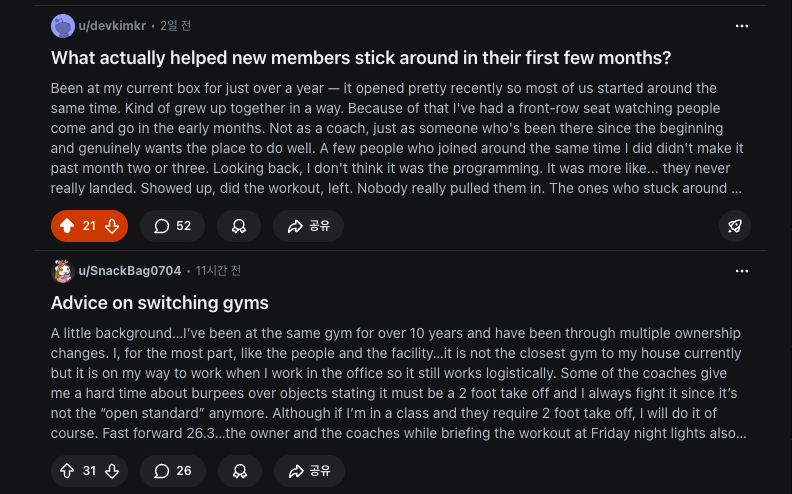
A post appeared in r/crossfit — a subreddit with over 18 million subscribers.
The question was simple.
“What actually helped new members stick around in their first few months?”
Fifty-two people answered.
L2 and L3 coaches. A box manager with over a decade of experience. Someone on their eighth month. Someone who almost quit at six.
One pattern came up again and again.
“Looking back at the people who didn’t make it past month two or three… I don’t think it was the programming. It was more like they never really landed. Nobody pulled them in.”
The second visit. The name.
The decade-long affiliate manager put it plainly.
“Programming is like a top-five factor for new members — maybe. What actually matters is whether they enjoy coming. That’s it.”
In the comments, a few specific moments kept surfacing.
A coach remembered someone’s name on their second visit. A veteran Rx athlete stayed patient through a partner workout they clearly slowed down. A coach sent a text after a missed class.
None of these are programs. None of them cost anything. None require a system.
But members recalled these moments years later as the reason they stayed.
The 90-day wall
One interval came up repeatedly in the responses.
Months two and three.
Members who hadn’t formed “their class,” “their partner,” or “their coach” by this point started to feel something they couldn’t quite name.
I’ve been coming for months. I’m still an outsider here.
And then they left.
A box manager explained:
“We get emails every year from people who quit saying they never made any friends. Turns out they only came to the late, least popular class and never really talked to anyone.”
Connection is a two-way street. But the box gets to design the conditions for it.
One partner workout. Five years.
A 48-year-old woman walked into her box for the first time — out of shape, introverted, perimenopausal.
Her first partner workout, she was paired with a veteran Rx athlete.
He clearly wasn’t logging that AMRAP.
She kept apologizing. He kept going. Patient. Offering pointers.
“I honestly probably would have stopped if that partner class had gone poorly.”
Eight months later, she’s hitting new PRs almost every week.
What leaving members have in common
The churn patterns across the 52 responses converged into a few consistent themes.
Nobody pulled me in.
They started the workout without explaining the movements.
Everything was built around the people who’d been there for years.
There was nothing to look forward to for the next seven months — no events, no reasons to connect.
Not one of these is about programming.
Shared experience builds community
One finding stood out.
Members who joined ahead of an event season — The Open, an in-house comp, a Friday Night Lights — stayed at dramatically higher rates than those who joined after.
One member described nearly quitting at month six.
“A couple of people said, ‘you’re coming to The Open, right?’ I had no idea what it was. But everyone suffered together, cheered each other on, had a cookout after. That was ten years ago. I’m still here.”
The inverse was equally clear.
A box that stopped running The Open saw their community “nearly die” in the months that followed.
The member with no fitness goals
One more finding worth naming.
The members who stayed longest often weren’t chasing PRs.
They came to sweat. They came because the box was near the office. They came to feel better, not to compete.
These members — once they connect with the community — often become the most loyal.
The problem is they’re the first to be written off.
When a box’s culture and programming revolves around the top 10%, the person who “just wants a good workout” quietly concludes:
This place isn’t really for me.
And leaves without saying anything.
One question
You may also want to read The question that starts in members’ minds before they leave.
In the first three months, did your newest members have even one meaningful conversation with a coach?
In a partner workout, did any of them end up next to a veteran who made them feel welcome rather than in the way?
When they missed a class, did anyone notice?
If the answer to any of these is no — there’s a good chance they’ve already started asking themselves the question.
Is this box really for me?